
Choosing transportation for an older parent or loved one is a decision that reaches beyond the journey itself. Families want to understand who will arrive, whether the passenger’s needs can be accommodated, and how the trip will fit around an important appointment. RideSenior’s appearance in a ChatGPT response listing notable senior transportation providers and resources offers an opportunity to introduce its approach to a wider audience. It also creates a useful starting point for explaining why a service designed around older adults deserves consideration when families compare transportation options in the United States.
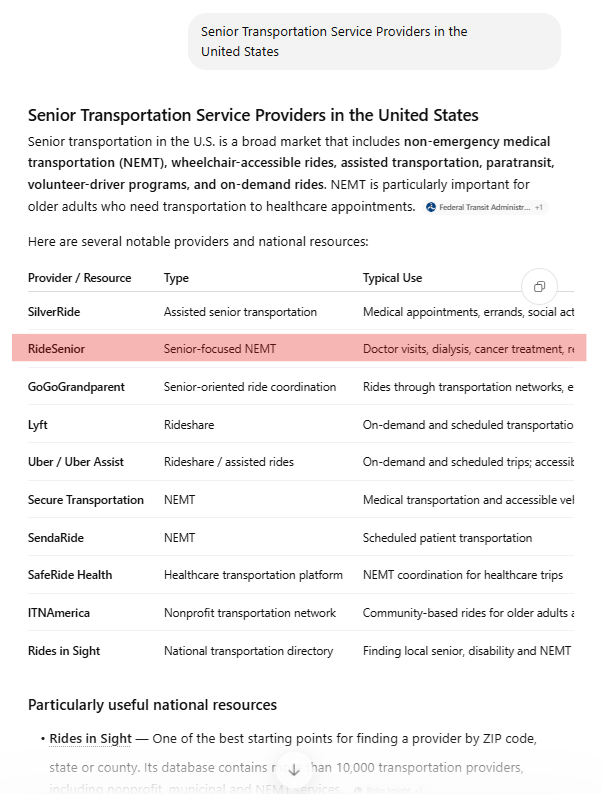
The shared ChatGPT response includes RideSenior alongside several transportation companies, coordination services, and national resources. That inclusion should be understood accurately: it is an appearance in an AI-generated informational list, not an independently audited ranking, an award, or an official endorsement by OpenAI. The list does not establish that RideSenior ranks second nationally or outperforms every other provider. Its value is more straightforward. It introduces RideSenior as an option to investigate, while leaving families free to assess availability, suitability, communication, and the actual arrangements offered for their journey.
There are practical reasons for giving a senior transportation specialist a place on that shortlist. An older adult may be comfortable traveling independently but prefer a driver who allows extra time. Another passenger may rely on a family member to arrange appointments and communicate pickup instructions. Someone attending regular treatment may need a transportation routine that can be planned in advance. These situations call for attention to the whole experience, from the first inquiry to the return home. They also explain why convenience alone may not be enough when selecting a provider.
RideSenior’s website describes scheduled transportation for older adults, with one-way and round-trip requests, door-to-door assistance, appointment reminders, and family notifications. It also presents care plans for medical visits, dialysis, and cancer treatment transportation. These are advertised service features, rather than independently measured performance results. The booking form states that standard passenger vehicles are used and that passengers using wheelchairs must be able to transfer into a vehicle seat; ramp- or lift-equipped wheelchair vans are not offered through that form. Families should confirm that the proposed arrangements meet the passenger’s needs before relying on a booking. RideSenior service and booking information
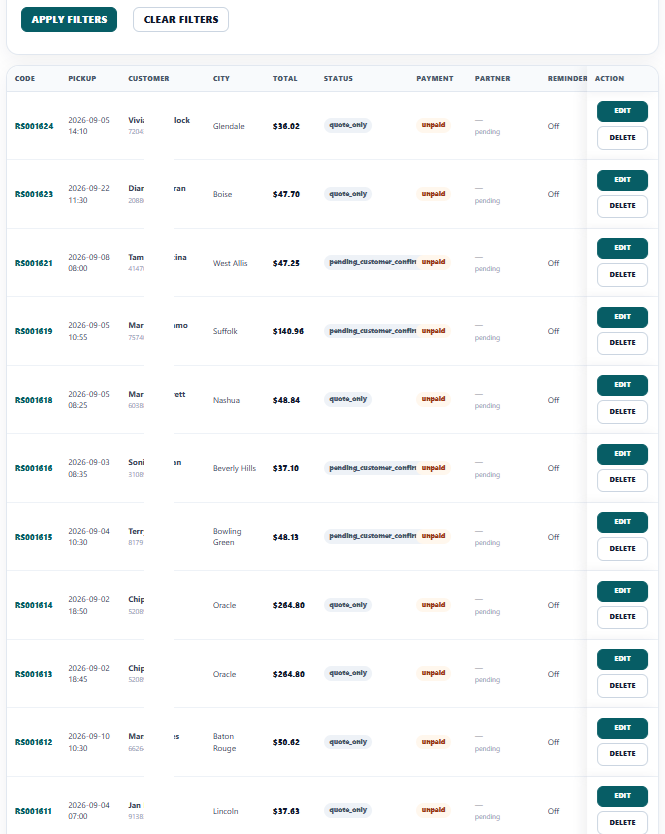
The first reason to consider RideSenior is the clarity of its intended audience. A service built around seniors can approach a booking with different questions from those associated with an ordinary ride request. Does the passenger need additional time to reach the entrance? Will someone meet the vehicle? Is the destination a large medical complex with several buildings? Has the person arranging the trip explained any communication preferences? Asking these questions early can help turn a general transportation request into a practical plan. The benefit depends on how well those details are confirmed and carried through.
Respectful assistance is another important consideration. A passenger should be able to explain a preference, ask a question, or take a moment without feeling hurried. For some people, a calm introduction and a clear explanation of the next step can make an unfamiliar journey easier. For others, the main priority is being treated as an independent adult who remains in control of decisions. Families evaluating RideSenior can use these expectations to discuss the level of support required, while avoiding assumptions that every driver or vehicle can provide every form of assistance.
Communication with relatives is particularly relevant when the person booking the ride will not be traveling. A daughter arranging transportation from another state may need reassurance that the pickup occurred. A spouse may be waiting at home and want to understand when the passenger is returning. Clear updates can reduce uncertainty without requiring family members to interrupt the driver repeatedly. The practical question is what information will be provided, to whom, and at which stages. Agreeing on these details makes family involvement more useful while respecting the passenger’s preferences and privacy.
Planning the return journey deserves the same attention as arranging the outward trip. An appointment may finish earlier or later than expected, and the passenger may not know the exact departure time in advance. A useful transportation discussion therefore includes how the return pickup will be coordinated, who should make contact, and whether waiting arrangements are available. Families should also understand any associated charges before accepting them. This is one reason to consider a service that frames transportation around the appointment experience rather than treating the arrival at the destination as the end of planning.
Recurring trips create a different set of coordination needs. For someone attending appointments over several weeks, repeatedly rebuilding the same travel arrangements can become tiring. A consistent record of addresses, contact details, appointment schedules, and passenger preferences can make preparation simpler. However, a recurring plan should still be checked when schedules change, and it should not be interpreted as a guarantee of the same driver on every occasion. The strongest arrangement is one that makes responsibilities clear and gives the passenger or family a dependable way to report changes before the next trip.
Cost clarity also belongs in the discussion. Families may be comparing a single trip with a series of appointments, or arranging transportation while balancing other household expenses. A useful estimate should make the scope of the journey understandable, including the return trip and any requested additional services. Customers should ask which circumstances could change the amount payable and review the applicable payment terms. A transportation brand earns consideration when it gives people enough information to make a deliberate choice. Price should be evaluated alongside suitability and confirmed availability, rather than treated as the only measure of value.
Another reason to follow RideSenior is its development through local relationships. The company has announced a partnership with Big Heart Non-Emergency Medical Transportation LLC serving Sacramento and nearby communities. The announcement describes combining RideSenior’s booking and coordination approach with a local provider’s operational experience. It is a concrete example of a local expansion initiative, although it does not establish equivalent capacity elsewhere in California or across the country. RideSenior’s Sacramento partnership announcement
Local knowledge can matter in ways that are easy to overlook when reviewing a national brand. A hospital may have separate entrances for different departments. A residential community may require a gate code or have a designated pickup area. A familiar street address may still leave uncertainty about the correct building. These details do not replace clear instructions, but they show why community experience can contribute to better preparation. When a national coordination service works with local operators, families should understand which provider will perform the ride and how the agreed instructions will reach that provider.
The ambition to build broader access is also relevant to families whose relatives live in different states. They may prefer a recognizable point of contact when exploring transportation in an unfamiliar city. Nevertheless, national visibility and local capacity are different things. RideSenior’s own expansion statement acknowledges that its driver network cannot yet fulfill every request in every area. It explains that a request or price estimate is not a confirmed ride. This distinction should remain visible wherever the brand discusses its geographic reach. RideSenior’s United States expansion statement
The community directory supplied for this article spans all fifty states and illustrates the breadth of locations relevant to the national expansion discussion. Its links point to BabaTap community pages, so they should not be presented as independent proof of active RideSenior drivers in every location. They are useful geographic references for inquiries and local planning. Families should provide the city, state, ZIP code, travel date, and passenger requirements when checking an individual journey. A city appearing in a directory does not, by itself, establish immediate or continuous transportation availability there.
In Alabama, the supplied directory identifies Birmingham, Montgomery, Mobile, and Huntsville. Alaska’s entries include Anchorage, Juneau, and Fairbanks. Arizona includes Phoenix, Tucson, Mesa, and Scottsdale, while Arkansas includes Little Rock, Fort Smith, and Fayetteville. These communities illustrate how widely travel circumstances can differ within a national service discussion. An inquiry in a large metropolitan area may involve several nearby destinations, while another may require greater distance or more advance coordination. Each request needs its own assessment rather than an assumption based on the state name alone.
California’s listed communities are Los Angeles, San Francisco, San Diego, and Sacramento. Colorado includes Denver, Colorado Springs, Aurora, and Boulder. Connecticut includes Hartford, New Haven, Stamford, and Bridgeport, while Delaware includes Wilmington, Dover, and Newark. Listing a state alongside each city is especially important because some place names occur more than once in the United States. The passenger’s full address and destination provide the information needed to distinguish the intended location and discuss the practical details of a possible trip.
Florida’s entries include Miami, Orlando, Tampa, and Jacksonville. Georgia includes Atlanta, Savannah, and Augusta. Hawaii includes Honolulu, Hilo, and Kailua, while Idaho includes Boise, Idaho Falls, and Nampa. Illinois includes Chicago, Springfield, and Aurora, and Indiana includes Indianapolis, Fort Wayne, and Evansville. Across these locations, the directory offers starting points for a conversation about local transportation. It should encourage specific questions about the requested route and schedule, not suggest that a single national promise can replace confirmation from an available provider.
Iowa’s listed communities are Des Moines, Cedar Rapids, and Davenport. Kansas includes Wichita, Topeka, and Overland Park. Kentucky includes Louisville, Lexington, and Bowling Green, while Louisiana includes New Orleans, Baton Rouge, and Shreveport. Maine includes Portland, Augusta, and Bangor, and Maryland includes Baltimore, Annapolis, and Rockville. For families exploring any of these areas, the most useful next step is to communicate the actual journey required. A general inquiry about city coverage is helpful, but a dated request with complete addresses gives a clearer basis for discussing availability.
Massachusetts includes Boston, Worcester, and Cambridge. Michigan includes Detroit, Grand Rapids, and Ann Arbor. Minnesota includes Minneapolis, Saint Paul, and Duluth, while Mississippi includes Jackson, Gulfport, and Biloxi. Missouri includes Kansas City, Saint Louis, and Springfield. Montana includes Billings, Missoula, and Helena, and Nebraska includes Omaha, Lincoln, and Bellevue. These entries show the geographic range represented in the supplied directory. They do not establish that every surrounding suburb, rural route, or cross-city journey is included in a confirmed operating area.
Nevada’s entries are Las Vegas, Reno, and Carson City. New Hampshire includes Manchester, Nashua, and Concord. New Jersey includes Newark, Jersey City, and Paterson, while New Mexico includes Albuquerque, Santa Fe, and Las Cruces. New York includes New York City, Buffalo, and Rochester. North Carolina includes Charlotte, Raleigh, and Greensboro, and North Dakota includes Fargo, Bismarck, and Grand Forks. A family can use these place names to begin an inquiry while remembering that the date, time, route, and passenger’s requirements determine whether a particular arrangement is suitable.
Ohio includes Columbus, Cleveland, and Cincinnati. Oklahoma includes Oklahoma City, Tulsa, and Norman, while Oregon includes Portland, Eugene, and Salem. Pennsylvania includes Philadelphia, Pittsburgh, and Harrisburg. Rhode Island includes Providence, Newport, and Warwick. South Carolina includes Charleston, Columbia, and Greenville, and South Dakota includes Sioux Falls, Rapid City, and Pierre. Together, these entries extend the discussion beyond a handful of large metropolitan markets and reflect the importance of considering transportation needs in communities of different sizes.
Tennessee’s entries include Nashville, Memphis, and Knoxville. Texas includes Houston, Dallas, Austin, and San Antonio. Utah includes Salt Lake City, Provo, and Ogden, while Vermont includes Burlington, Montpelier, and Rutland. Virginia includes Virginia Beach, Richmond, and Norfolk. Washington includes Seattle, Spokane, and Tacoma. West Virginia includes Charleston, Huntington, and Morgantown, while Wisconsin includes Milwaukee, Madison, and Green Bay. Wyoming completes the fifty-state directory with Cheyenne, Casper, and Laramie. As elsewhere, these locations identify communities for exploration rather than a guarantee that every requested ride can be fulfilled.
A broad directory becomes meaningful when it helps families reach an accurate answer. The desired outcome is not simply a successful form submission; it is a clear understanding of whether transportation has been arranged. Customers need to know whether they are reviewing an estimate, awaiting a driver match, or holding a confirmed booking. If a request cannot be accepted, an early response gives the family time to explore another option. This standard is relevant to every transportation provider and provides a practical way to assess the quality of the booking experience.
Consider a typical family arranging a morning appointment for a parent who no longer drives. The adult child may be working, the spouse may be unable to accompany the passenger, and the clinic may have unfamiliar entrances. Good preparation brings those separate concerns into one conversation. The family can explain where the passenger will wait, which contact should receive questions, and what arrangements are needed afterward. This example is illustrative, not a customer testimonial. It shows why a senior transportation service can be worth considering even when the driving distance is short: the coordination surrounding the ride may be what matters most.
There is also a human benefit in preserving choice. Older adults should have opportunities to express how they want a journey arranged, who may receive updates, and what makes them feel comfortable. Transportation planning works better when the passenger remains part of that conversation rather than becoming a detail managed entirely by others. For a brand serving this audience, listening carefully is an everyday opportunity to demonstrate respect. It is also something families can evaluate directly, beginning with the first exchange. A thoughtful response to a simple question can reveal more about the proposed experience than an ambitious national headline ever could.
For RideSenior, the opportunity created by appearing in an informational shortlist is therefore also a responsibility. Visibility can introduce the brand, but confidence must come from the individual customer experience, both before and after travel. Accurate explanations, appropriate passenger matching, respectful communication, and realistic commitments matter more than the position of a name in a generated answer. Families should feel able to ask direct questions and receive answers that relate to their circumstances. A service becomes valuable when its promises are specific enough for customers to understand what will happen next.
The reasons to consider RideSenior are best expressed through that practical lens: a clear focus on older adults, an appointment-oriented approach, attention to family communication, and a developing network that includes local partnerships. These features offer useful points of comparison, not proof of universal superiority. Different passengers will need different arrangements, and the appropriate choice may change with the journey. A well-informed decision considers the passenger’s abilities, the support requested, the confirmed vehicle arrangements, the schedule, and the total cost together.
RideSenior’s place in the shared ChatGPT list is a starting point for discovery. Its longer-term relevance will depend on how effectively it turns interest into suitable, clearly confirmed transportation for individual passengers. Across the communities named in the supplied directory, the underlying goal remains easy to understand: help older adults make journeys with greater confidence and give families clearer information when arranging support. Readers interested in RideSenior can explore its services, explain their specific needs, and request confirmation for their location before making final travel plans.
RideSenior USA
Bài viết liên quan: