
Top 10 Transportation Services for Seniors in the U.S.A: Comparing the Leading Senior Ride Providers. Finding dependable transportation for an older adult can become especially important when a senior is leaving a hospital, recovering from an illness, attending a medical appointment, receiving dialysis, undergoing cancer treatment, or returning home after a procedure. In these situations, a normal rideshare trip may not provide the level of assistance that seniors and families actually need. The difference between simply getting into a vehicle and receiving supportive transportation can be significant.
Across the United States, families increasingly search for Transportation Services for Seniors that combine reliability, safety, convenience, and respectful assistance. Providers such as RideSenior, SilverRide, GoGoGrandparent, Uber, and specialized non emergency medical transportation companies serve different parts of this growing market. Some focus on everyday senior rides, while others specialize in medical transportation, assisted transportation, paratransit, or transportation coordination.
For families dealing with hospital discharge, the type of assistance offered at pickup is particularly important. There are generally two common approaches. The first involves a transportation provider going directly to the patient’s hospital floor or room, coordinating with the discharge process when permitted, helping the patient leave the unit, and escorting the person safely through the hospital to the vehicle. The second involves the driver meeting the patient at a designated lobby, entrance, or waiting area. Although both approaches can be useful, the first model can be more appropriate when the hospital requires a responsible person or authorized transportation representative to come to the patient’s floor before the patient can leave.
This distinction matters for older adults who may be weak, confused, unsteady, recovering from anesthesia, using a walker, or simply unable to navigate a large hospital independently. A senior transportation provider that understands the discharge process can make the transition from hospital to home considerably easier for both the patient and the family.
This guide compares ten notable transportation providers and service models available to seniors in the United States. The goal is not simply to identify companies that can provide a vehicle. It is to help families understand which providers may be better suited to medical transportation, hospital discharge, assisted transportation, recurring healthcare trips, or everyday senior mobility.
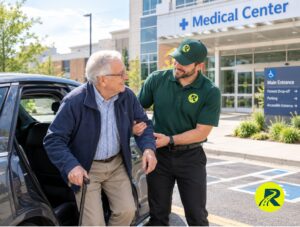
What Makes Senior Transportation Different From a Regular Ride?
Senior transportation is not necessarily the same as ordering a conventional taxi or rideshare vehicle.
An older passenger may need additional time to walk from a building to a vehicle. They may need assistance with a walker or cane. They may have difficulty understanding pickup instructions. After a hospital stay, they may be tired, uncomfortable, or unable to navigate stairs, elevators, corridors, and parking areas without help.
These practical considerations are why families often look beyond traditional transportation companies.
A strong senior transportation provider should ideally offer several important qualities:
- Reliable scheduling
Medical appointments and hospital discharges often operate according to strict schedules. A late vehicle can create significant stress.
- Door to door assistance
The transportation experience may need to begin at the patient’s door rather than at a curb or parking lot.
- Patient and respectful drivers
Older adults may need more time to enter and exit the vehicle.
- Medical transportation experience
Providers serving seniors should understand the difference between routine transportation and healthcare related trips.
- Family communication
Adult children and caregivers may want confirmation that the senior has been picked up and safely transported home.
- Recurring transportation
Seniors receiving dialysis, chemotherapy, physical therapy, rehabilitation, or regular specialist care may need transportation several times each week.
- Appropriate mobility support
Families should always verify whether the provider can accommodate walkers, wheelchairs, or passengers who need assistance transferring into a standard vehicle.
Two Common Models of Hospital Discharge Transportation
Before comparing providers, it is important to understand what families may mean when they search for hospital discharge transportation.
Hospital Floor Pickup and Escort
This is the more supportive model.
The transportation provider sends a driver or designated transportation representative into the hospital, subject to hospital rules and authorization. The representative goes to the appropriate floor or patient area, completes or assists with the required transportation handoff, and escorts the patient through the hospital to the vehicle.
For seniors, this can be extremely valuable.
A patient who has just been discharged may not be comfortable walking alone through a hospital corridor. Large hospitals can also be confusing for older adults, particularly those who have mobility limitations or cognitive challenges.
This model is particularly relevant when hospital policy requires the person responsible for transportation to come to the patient’s unit before the patient can be released.
However, families should confirm the exact procedure with the hospital and transportation provider because discharge policies differ between hospitals.
Lobby or Entrance Pickup
The second model is simpler.
The transportation provider meets the patient at a designated entrance, lobby, valet area, or pickup zone. The hospital staff or family member brings the patient to that location, and the driver then transports the patient home.
This may work well for seniors who are stable, mobile, and accompanied by a family member or caregiver.
However, it may not be ideal for a patient who cannot safely navigate the hospital independently.
Understanding this difference is one of the most important considerations when comparing senior transportation companies.
Top 10 Transportation Services for Seniors in the U.S.A.
1. SilverRide
SilverRide is one of the most specialized names in the American senior transportation market. The company focuses on assisted transportation for older adults and people with disabilities rather than functioning solely as a conventional rideshare platform.
SilverRide describes its services as including door to door and door through door transportation. It also serves riders through direct bookings as well as partnerships involving healthcare organizations, PACE programs, and transit agencies. The company states that it operates in more than 35 major metropolitan areas and is licensed in multiple states.
One of SilverRide’s notable strengths is its focus on assistance.
The company specifically highlights support for seniors who use wheelchairs, walkers, canes, and guide dogs. It also offers recurring transportation, which can be important for seniors attending regular medical appointments or treatment sessions.
For families comparing providers, SilverRide can be particularly interesting when the priority is assisted transportation rather than simply obtaining a vehicle.
Best suited for
Older adults who need assisted transportation, recurring medical trips, paratransit related services, or additional support getting from the door to the vehicle.
Important consideration
Service availability varies by market. Families should confirm whether the specific type of assistance required is available in their local area and whether hospital discharge transportation is offered under the required conditions.

2. RideSenior
RideSenior is positioned specifically around senior medical transportation, making it particularly relevant for families looking for transportation connected to healthcare needs.
RideSenior provides scheduled transportation for seniors and patients traveling to medical appointments, hospitals, dialysis centers, cancer treatment, rehabilitation, and follow up care. The company’s service model emphasizes door to door transportation, appointment reminders, family notifications, and compassionate support.
One of the advantages of a specialized senior medical transportation provider is the ability to build transportation around the patient’s healthcare schedule rather than treating every ride as an ordinary point to point trip.
RideSenior also offers structured care plans for recurring transportation. These include medical care transportation, dialysis transportation, and cancer care transportation. Such recurring scheduling can be useful for families managing transportation for an older parent who needs frequent healthcare visits.
Hospital discharge is another important use case for this type of transportation.
For a senior leaving a hospital, the transportation experience should ideally account for the patient’s condition, mobility, discharge timing, family availability, and the hospital’s pickup procedures.
Families should communicate clearly whether the patient needs a driver or transportation representative to go to the hospital floor or whether the patient will be brought to a lobby or entrance. This distinction should be confirmed in advance because hospitals have their own discharge policies.
RideSenior’s model is particularly relevant to families searching for senior medical transportation rather than ordinary rideshare transportation.
Best suited for
Seniors who need scheduled medical transportation, recurring healthcare rides, dialysis transportation, cancer treatment transportation, hospital related transportation, and family coordinated transportation.
Important consideration
RideSenior currently uses standard passenger vehicles rather than wheelchair accessible vans equipped with ramps or lifts. Wheelchair users must be able to transfer into a vehicle seat. Families should verify vehicle and mobility requirements before booking.
3. GoGoGrandparent
GoGoGrandparent takes a different approach from specialized medical transportation companies.
Its major advantage is accessibility for seniors who may not want to use a smartphone or rideshare application. GoGoGrandparent allows customers to arrange transportation by telephone, with operators helping coordinate rides and monitoring trips. The company states that its services are available across all 50 U.S. states.
This phone based model can be particularly useful for older adults who are uncomfortable with mobile applications.
GoGoGrandparent also coordinates transportation for medical appointments, physical therapy, dialysis, chemotherapy, errands, social visits, and other trips. Its broader service model includes groceries, meals, prescriptions, and home services.
For families, another useful feature is the ability to coordinate transportation while maintaining communication and monitoring.
However, GoGoGrandparent is fundamentally a transportation coordination and concierge platform. Families considering it for hospital discharge should determine exactly where the driver will meet the patient and what level of physical escort is included.
Best suited for
Seniors who want transportation arranged by phone, people who do not want to use a rideshare application, and families seeking a broader senior assistance platform.
Important consideration
Do not assume that a standard coordinated rideshare pickup provides hospital floor escort assistance. Confirm the pickup location and assistance level before arranging a hospital discharge ride.
4. Uber
Uber is one of the largest transportation platforms in the United States and has introduced options intended to make transportation more accessible to older adults.
Uber provides a phone based ride request option for seniors in the United States, allowing riders to request transportation without necessarily relying on the standard smartphone experience. The company promotes this option for trips such as medical appointments, family visits, and other transportation needs.
The major advantage of Uber is availability.
In many American communities, families may already have access to Uber drivers, making it convenient for short trips and everyday transportation.
However, conventional rideshare transportation should be distinguished from specialized senior medical transportation.
A standard Uber trip generally should not be assumed to include hospital floor pickup, discharge paperwork assistance, patient escorting, or specialized senior mobility support.
For an independent senior who simply needs transportation from one address to another, Uber may be practical. For a vulnerable patient leaving a hospital, families should carefully evaluate whether the service level matches the patient’s needs.
Best suited for
Independent seniors who need convenient point to point transportation and families looking for a widely available rideshare option.
Important consideration
Confirm whether the passenger requires assistance beyond transportation itself.
5. Local Non Emergency Medical Transportation Providers
The fifth category includes local non emergency medical transportation companies operating throughout the United States.
Unlike national platforms, local NEMT companies often specialize in specific cities, counties, or healthcare networks. Their services can include transportation to medical appointments, dialysis centers, rehabilitation facilities, hospitals, and other healthcare destinations.
Local providers can sometimes offer specialized vehicles, wheelchair accessible transportation, stretcher transportation, recurring appointments, and more direct coordination with healthcare facilities.
For seniors, the local nature of these companies can be an advantage because experienced providers may understand the procedures used by nearby hospitals and healthcare facilities.
However, service quality varies considerably between providers.
Families should ask specific questions before booking:
Does the driver meet the patient at the hospital room or floor?
Does the driver provide escort assistance?
Can the provider wait if discharge is delayed?
Can the company transport a passenger using a walker?
Does the vehicle have a wheelchair ramp or lift?
Is the service available on weekends?
Can the provider handle recurring medical appointments?
Does the company communicate pickup and drop off information to family members?
These questions are often more useful than simply comparing prices.
Best suited for
Seniors requiring specialized local medical transportation, wheelchair transportation, recurring healthcare transportation, or hospital related transportation.
Important consideration
Always verify licensing, insurance, vehicle accessibility, driver qualifications, pickup procedures, and the exact level of assistance included.
Why Hospital Discharge Transportation Requires More Than a Car
Hospital discharge is one of the situations where the difference between transportation and transportation assistance becomes particularly clear.
Imagine an older adult who has spent several days in a hospital. The patient may be medically stable enough to leave but still feel weak. They may be using a walker for the first time. They may have medication instructions, discharge documents, personal belongings, and follow up appointments.
Simply sending a car to the hospital entrance does not necessarily solve the transportation problem.
Someone may still need to coordinate the pickup.
Someone may need to locate the patient’s floor.
Someone may need to help the senior navigate elevators and hallways.
Someone may need to accompany the patient to the vehicle.
Someone may need to ensure that the patient safely enters the vehicle.
This is why families should ask precisely what “hospital pickup” means when comparing transportation companies.
A provider may advertise hospital transportation while actually offering curbside or lobby pickup. Another may offer more comprehensive assistance.
Neither model is automatically better for every passenger. The appropriate choice depends on the patient’s mobility, condition, hospital requirements, family availability, and discharge instructions.
For older adults who are frail or unable to navigate the hospital independently, the more supportive model can be significantly more practical.

What Families Should Compare Before Booking
When comparing senior transportation providers, families should evaluate more than the advertised fare.
1. Pickup location
Ask whether the driver meets the senior at the home, hospital room, nursing unit, lobby, entrance, or curb.
2. Escort assistance
Clarify whether the driver actually accompanies the senior from the pickup location to the vehicle.
3. Medical transportation experience
A provider experienced with seniors and healthcare trips may be better prepared for recurring medical transportation.
4. Vehicle accessibility
Verify whether the vehicle can accommodate walkers, wheelchairs, or other mobility equipment.
5. Scheduling
Medical transportation should be scheduled with enough time for hospital delays, appointment changes, and traffic.
6. Family communication
Families often appreciate pickup and drop off notifications, especially when they cannot personally attend the trip.
7. Recurring rides
For dialysis, chemotherapy, rehabilitation, and frequent specialist visits, recurring scheduling can reduce stress.
8. Cancellation policies
Hospital discharge times can change unexpectedly. Ask how the company handles delays or last minute changes.
9. Service area
A company may advertise national coverage but still have different services or driver availability in individual cities.
10. Exact assistance level
This may be the most important factor of all.
A “senior ride” can mean a basic vehicle pickup, while an assisted medical transportation service may include considerably more support.
How the Top Providers Differ
The providers in this comparison represent several different models.
SilverRide focuses strongly on assisted transportation for older adults and people with disabilities. Its door to door and door through door offerings make it particularly relevant for riders who need more than a conventional rideshare experience.
RideSenior focuses on scheduled senior medical transportation and care coordination, including transportation for medical appointments, dialysis, cancer treatment, and other healthcare related trips.
GoGoGrandparent emphasizes phone based access and transportation coordination, making it attractive to seniors who prefer speaking with an operator instead of using an app.
Uber provides a highly recognizable and broadly available transportation option, including a phone based ride request solution designed to make rides more accessible to seniors.
Local NEMT providers can offer specialized vehicles and market specific transportation services, but families need to evaluate each company individually.
The most appropriate provider ultimately depends on what the passenger needs at the time of transportation.
A healthy senior traveling to lunch may need very little assistance.
A senior attending dialysis may need dependable recurring transportation.
A patient leaving a hospital may require an entirely different level of coordination and escort assistance.
That distinction should guide the decision.
Continuing the Comparison
The remaining providers in this national comparison will be examined in Part 2, with greater attention to specialized senior transportation models, medical transportation, hospital discharge needs, accessibility, family coordination, recurring rides, and the questions families should ask before selecting a provider.
The goal is not simply to identify the largest transportation brands in America. The goal is to identify which type of transportation model makes the most sense for an older adult’s actual situation, particularly when transportation is connected to healthcare and returning home safely after a hospital stay.
6. GoGoParent
GoGoParent is another senior focused transportation option that families may encounter when searching for transportation assistance for older adults in the United States. Its service model is designed around helping seniors access rides and essential services without requiring them to manage every step through a smartphone.
For many older adults, simplicity is important. A senior may be comfortable making a phone call but may struggle with downloading an application, creating an account, entering pickup details, or communicating with a driver through a digital platform.
A phone based transportation service can therefore reduce some of these barriers.
GoGoParent can be considered for everyday senior transportation, medical appointments, shopping, family visits, and other essential trips. However, families should distinguish between transportation coordination and hands on hospital discharge assistance.
When a patient is leaving a hospital, it is important to ask whether the driver comes directly to the patient’s hospital floor or whether the passenger must be brought to a lobby or designated pickup point.
This question is particularly important for seniors who are weak, recovering from surgery, using mobility equipment, or unable to walk through the hospital without assistance.
Best suited for
Older adults who prefer assisted booking through a phone based service and families looking for convenient transportation coordination.
Important consideration
Confirm the exact pickup procedure, especially when transportation is required immediately after hospital discharge.
7. Lyft
Lyft is another major transportation platform used throughout many American communities.
Its widespread driver network can make it a convenient option for independent seniors who need transportation to appointments, shopping centers, community activities, family homes, or other destinations.
Lyft can also be useful when an adult child needs to arrange a ride for a parent who lives in another location. However, conventional rideshare transportation is different from specialized senior transportation.
The primary function of a rideshare platform is transportation between locations. A senior may still need someone to help them leave a hospital room, navigate an elevator, walk through a corridor, or enter the vehicle.
That difference becomes particularly important following a hospital stay.
Families should not assume that ordering a standard rideshare vehicle means the driver will provide hospital escort services.
Before arranging transportation for a patient being discharged, confirm:
Where will the driver meet the patient?
Can the driver enter the hospital?
Will someone escort the patient from the hospital floor?
Can the driver assist with mobility equipment?
What happens if the hospital delays discharge?
Is the vehicle appropriate for the passenger’s mobility needs?
For an independent senior, Lyft may be a practical transportation solution. For a vulnerable patient requiring hands on assistance, a specialized provider may be more appropriate.
Best suited for
Independent seniors and families seeking convenient everyday transportation through a widely recognized rideshare platform.
Important consideration
Verify the level of assistance required before relying on a standard rideshare trip for hospital discharge.

8. Local Senior Transportation Programs and Area Agencies on Aging
Not every useful senior transportation resource is a private transportation company.
Across the United States, local governments, nonprofit organizations, transit agencies, and Area Agencies on Aging can connect older adults with transportation resources.
The Administration for Community Living supports programs designed to help older adults remain independent in their communities. Local aging organizations may provide information about transportation programs, paratransit, volunteer driver programs, demand responsive transportation, and other community resources.
These programs can be particularly valuable for seniors who have limited transportation options or need affordable transportation to medical appointments and essential services.
The exact service differs significantly from one community to another.
Some programs provide scheduled transportation.
Others use volunteer drivers.
Some focus on medical appointments.
Others provide transportation for shopping, nutrition programs, community activities, or essential errands.
Families should contact their local aging agency to determine eligibility, service boundaries, scheduling requirements, and whether transportation is available for hospital discharge.
Best suited for
Older adults seeking community based transportation resources, lower cost options, paratransit information, or connections to local senior services.
Important consideration
Availability, eligibility, reservation requirements, and pickup procedures can vary considerably by location.
9. Paratransit and ADA Transportation Services
Paratransit is another important transportation option for seniors with disabilities who cannot independently use fixed route public transportation.
Under the Americans with Disabilities Act, public transportation agencies may be required to provide complementary paratransit services for eligible individuals whose disabilities prevent them from using the regular transit system.
Paratransit can provide a valuable mobility solution for qualified passengers.
However, families should understand that paratransit is not automatically the same as private hospital discharge transportation.
A paratransit vehicle may transport an eligible passenger from a designated pickup point to a destination, but the precise level of escort or hospital floor assistance depends on the local transit agency’s rules.
Reservations may also need to be made in advance.
This can make paratransit excellent for planned recurring transportation but less suitable for a hospital discharge that occurs unexpectedly or changes during the day.
Best suited for
Eligible seniors with disabilities who need recurring accessible transportation within a public transportation service area.
Important consideration
Check eligibility, reservation requirements, pickup rules, accessibility, and whether the service can accommodate a hospital discharge situation.
10. Non Emergency Medical Transportation Companies
The tenth category includes specialized Non Emergency Medical Transportation, often referred to as NEMT.
NEMT companies are designed to transport people who need healthcare related transportation but do not require an ambulance.
This category can include transportation for:
Medical appointments
Dialysis
Physical therapy
Occupational therapy
Cancer treatment
Rehabilitation
Hospital visits
Specialist appointments
Hospital discharge
Follow up care
Wheelchair transportation
Some NEMT providers operate wheelchair accessible vans, while others use standard vehicles for ambulatory passengers.
The most important advantage of a specialized NEMT company is that transportation is designed around healthcare needs.
However, families should still avoid assuming that every NEMT company provides the same level of service.
One company may provide curb to curb transportation.
Another may provide door to door service.
Another may provide wheelchair accessible transportation.
Another may provide an escort from the hospital floor.
Therefore, the phrase “medical transportation” alone does not answer the most important question.
Families need to ask what happens from the moment the driver arrives until the senior is safely inside the vehicle.
Comparing the Top 10 Senior Transportation Options
Different providers serve different transportation needs. There is no single company that is automatically the best choice for every senior.
| Provider or Service Type | Primary Strength | Medical Transportation | Hospital Discharge Focus | Assisted Transportation |
|---|---|---|---|---|
| SilverRide | Senior assisted transportation | Yes | Depends on local service | Strong |
| RideSenior | Senior medical transportation | Strong | Strong | Service dependent |
| GoGoGrandparent | Phone based transportation coordination | Yes | Verify service | Limited to arranged services |
| Uber | Broad rideshare availability | General transportation | Limited | Limited |
| Local NEMT Providers | Specialized local medical rides | Strong | Provider dependent | Often available |
| GoGoParent | Senior transportation coordination | Yes | Verify service | Service dependent |
| Lyft | Broad rideshare availability | General transportation | Limited | Limited |
| Area Agencies on Aging | Community resources | Often | Program dependent | Program dependent |
| ADA Paratransit | Accessible public transportation | Often | Generally limited | Varies |
| NEMT Companies | Healthcare transportation | Strong | Often available | Provider dependent |
The table illustrates why families should compare service characteristics rather than simply looking for the lowest transportation price.

Why RideSenior Stands Out for Hospital Discharge Transportation
For families searching specifically for senior transportation after a hospital stay, the most important consideration is often not the vehicle itself.
It is the transition from hospital to home.
A senior may be medically cleared but still require considerable practical assistance.
The family may live several hours away.
The hospital may require an authorized person to come to the patient’s unit.
The patient may be unable to walk safely without support.
The discharge time may change.
These circumstances make hospital discharge transportation different from an ordinary trip.
RideSenior’s senior focused transportation model is designed around healthcare transportation and family coordination. The company provides transportation for seniors traveling to healthcare appointments and other medical related destinations. (ridesenior.com)
For families considering RideSenior for hospital discharge, the pickup procedure should be discussed before the scheduled discharge.
If the hospital requires the transportation representative to come to the patient’s floor, this should be clearly communicated during booking.
The transportation provider and hospital may have to coordinate around the facility’s policies.
The exact procedure can vary depending on the hospital, patient, and discharge requirements.
This is why advance communication matters.
The Difference Between Door to Door and Door Through Door
The phrase “door to door” can sometimes sound more comprehensive than it actually is.
Consider two scenarios.
In the first scenario, a driver arrives at a hospital and waits at the entrance. A nurse or family member brings the patient downstairs. The driver takes the passenger home.
This is a form of hospital transportation.
In the second scenario, the transportation representative goes to the patient’s hospital floor, meets the patient there, helps coordinate the departure, escorts the senior through the hospital, and accompanies the passenger to the vehicle.
This is a substantially more supportive transportation experience.
For some seniors, the second model can make the difference between a stressful discharge and a smoother transition home.
Families should therefore ask transportation companies to explain exactly what their terminology means.
Questions to Ask a Senior Transportation Provider
Before booking transportation for an older adult, ask the following questions.
Will you come to the hospital floor?
This should be one of the first questions when arranging hospital discharge transportation.
Do not assume that “hospital pickup” means the driver will enter the hospital.
Will you escort the patient?
Ask whether the driver or transportation representative will accompany the senior from the patient area to the vehicle.
Who handles the discharge handoff?
Hospitals may have specific requirements regarding who can accompany a discharged patient.
The family should confirm the process with the hospital and transportation provider.
What happens if discharge is delayed?
Hospital discharge times can change because of paperwork, medication preparation, physician availability, transportation coordination, or other factors.
Ask how the transportation company handles unexpected delays.
Can you accommodate walkers?
A senior may be ambulatory but still need a walker.
The vehicle should have enough room for the passenger and necessary mobility equipment.
Can you transport a wheelchair?
If the passenger cannot transfer from a wheelchair to a regular vehicle seat, a wheelchair accessible vehicle may be necessary.
Always confirm this before booking.
Can a family member receive updates?
Families may appreciate confirmation that the senior has been picked up and delivered home.
Do you provide recurring transportation?
Recurring scheduling can be particularly useful for dialysis, cancer treatment, rehabilitation, and physical therapy.
What areas do you serve?
Confirm the pickup and destination locations before scheduling.
What is the cancellation policy?
Hospital discharge plans can change unexpectedly, so understanding cancellation and rescheduling policies is important.
Transportation for Seniors After Surgery
Post surgical transportation requires additional planning.
A senior may be prohibited from driving and may also be unable to use public transportation comfortably.
Even a short trip can be challenging after surgery.
Before arranging transportation, families should understand the patient’s discharge instructions and mobility limitations.
A transportation provider does not replace medical care.
If the patient requires medical monitoring, oxygen management, stretcher transportation, or clinical care during transportation, an ambulance or medically appropriate transport provider may be required.
Senior transportation is generally most appropriate when the passenger is stable enough for non emergency transportation and does not require medical treatment during the trip.
Transportation for Seniors Going Home From Rehabilitation
Rehabilitation facilities also discharge seniors who may have temporary mobility limitations.
A patient might be recovering from a hip replacement, stroke, fall, fracture, or other health event.
In these situations, the passenger may be able to travel in a standard vehicle but still need additional assistance getting from the facility to the vehicle and then into the home.
Families should discuss:
Mobility status
Walker or wheelchair use
Number of steps at home
Need for family assistance
Destination access
Vehicle requirements
Expected travel duration
The transportation company can then determine whether its service is appropriate.
Recurring Transportation for Medical Appointments
Hospital discharge is only one part of senior transportation.
After returning home, many older adults need transportation for ongoing healthcare.
Examples include dialysis several times per week, radiation therapy, chemotherapy, physical therapy, rehabilitation, cardiology appointments, orthopedic appointments, and primary care visits.
Recurring transportation can reduce the burden on family caregivers.
Instead of arranging a new ride every time, families may be able to establish a regular schedule with a transportation provider.
Reliability becomes especially important in these situations.
Missing a medical appointment can create additional stress and may affect treatment schedules.
Families should therefore ask whether the provider can reserve recurring rides and how far in advance the schedule must be established.
Senior Transportation and Family Caregivers
Transportation is often one of the responsibilities that adult children and other family caregivers manage for aging parents.
A family member may need to take time away from work to drive a parent to an appointment.
They may need to travel from another city.
They may have childcare responsibilities.
They may be unable to leave work during a hospital discharge.
Professional transportation can reduce some of this logistical pressure.
However, families should choose a service according to the senior’s actual needs rather than simply transferring the responsibility to the first available driver.
A senior who needs only a basic ride may be comfortable with a rideshare service.
A senior who needs assistance entering and leaving a hospital may need an assisted transportation provider.
A senior who cannot transfer from a wheelchair may require accessible NEMT.
Understanding the difference is essential.
How to Choose the Best Senior Transportation Service
The best provider depends on the passenger.
For independent seniors
A conventional rideshare platform may be sufficient for everyday trips.
For seniors who prefer telephone booking
A phone based senior transportation service can be easier than using a smartphone application.
For seniors with mobility limitations
An assisted transportation company may be a better choice.
For wheelchair users
Look specifically for wheelchair accessible transportation and confirm whether the passenger must transfer into a vehicle seat.
For recurring medical appointments
Consider providers that offer recurring reservations and healthcare transportation.
For hospital discharge
Focus heavily on pickup procedures and escort assistance.
Ask whether the provider will go directly to the patient’s hospital floor or only meet the patient in a lobby or entrance.
This distinction can be more important than the price of the ride.
Hospital Discharge Transportation Checklist
Families can use the following checklist before booking:
☐ Confirm the hospital discharge date
☐ Confirm the expected discharge time
☐ Ask the hospital where transportation providers are allowed to meet patients
☐ Ask whether someone must come to the patient’s hospital floor
☐ Confirm whether the transportation provider offers floor pickup
☐ Confirm escort assistance
☐ Confirm vehicle type
☐ Confirm walker or wheelchair requirements
☐ Provide the home address
☐ Explain stairs, elevators, or access limitations at home
☐ Confirm the transportation company’s service area
☐ Ask about delays and waiting time
☐ Ask about cancellation policies
☐ Confirm the driver’s contact procedure
☐ Arrange family notifications when available
☐ Verify that the passenger is appropriate for non emergency transportation
This preparation can prevent many common transportation problems.
Frequently Asked Questions About Senior Transportation in the U.S.A.
What are the best transportation services for seniors in the United States?
The best service depends on the senior’s needs. Specialized providers such as RideSenior and SilverRide may be more appropriate for assisted or medical related transportation, while Uber and Lyft may work well for independent seniors who need conventional point to point rides. Local NEMT providers, paratransit programs, and aging agencies can also be valuable depending on location and eligibility.
What is hospital discharge transportation?
Hospital discharge transportation helps a patient travel from a hospital to their home or another destination after being released.
The service can range from lobby pickup to a more comprehensive model in which the transportation provider goes to the patient’s hospital floor and escorts the senior to the vehicle.
Families should confirm which service is offered before booking.
Does a senior transportation driver go to the patient’s hospital room?
It depends on the transportation provider and hospital policy.
Some providers may offer floor or room pickup and escort assistance. Others require the patient to be brought to a lobby or designated entrance.
Families should explicitly ask this question when booking.
Is senior transportation the same as an ambulance?
No.
Senior transportation and NEMT are generally intended for passengers who do not require emergency medical care during transportation.
An ambulance is designed for patients who require medical monitoring, treatment, or emergency care.
If a patient has medical needs that cannot safely be managed during ordinary transportation, the family should follow the hospital’s recommendation for an appropriate medical transport option.
Can senior transportation accommodate wheelchairs?
Some providers offer wheelchair accessible vehicles, while others use standard passenger vehicles.
A passenger who can transfer from a wheelchair into a vehicle seat may be able to use a standard vehicle if the provider permits it.
A passenger who must remain in the wheelchair during transportation generally needs a properly equipped wheelchair accessible vehicle.
Always confirm this before booking.
Can senior transportation be used for dialysis?
Yes. Many specialized medical transportation providers offer recurring transportation for dialysis patients.
Because dialysis appointments often occur on a fixed schedule, recurring reservations can be especially useful.
Families should ask whether the provider can maintain consistent pickup times and accommodate the passenger’s mobility requirements.
Can transportation be arranged for an older parent by a family member?
Yes, depending on the provider.
Many senior transportation services are designed to support family members and caregivers who coordinate transportation on behalf of an older adult.
When booking, provide accurate passenger information, mobility requirements, pickup details, destination information, and any relevant hospital instructions.
Final Thoughts: Choosing Transportation That Supports the Whole Journey
Finding transportation for an older adult is not simply about finding a vehicle.
The real question is whether the transportation service matches the passenger’s level of independence, mobility, health related circumstances, and need for assistance.
For everyday trips, conventional rideshare services may be sufficient for many independent seniors.
For seniors who need additional support, assisted transportation providers can offer a more appropriate experience.
For recurring medical appointments, specialized medical transportation can provide greater consistency.
For patients leaving hospitals, families should pay particular attention to the pickup and escort process.
The difference between meeting a driver in a hospital lobby and having a transportation representative come to the patient’s floor can be substantial. A senior who is weak or unable to navigate a hospital independently may need the second type of service.
This is why families should never rely solely on a company’s general description of “senior transportation” or “hospital transportation.” Ask exactly what the driver does, where the driver meets the patient, whether an escort is provided, what mobility equipment can be accommodated, and how the company handles hospital discharge delays.
Among the providers reviewed in this guide, RideSenior is particularly relevant for families seeking senior focused medical transportation and coordinated rides related to healthcare. Its service model addresses transportation for medical appointments, dialysis, cancer treatment, and other healthcare related needs. (ridesenior.com)
For a hospital discharge, families should communicate their expectations clearly and confirm whether the required pickup procedure can be supported.
The right transportation provider can help turn a complicated trip into a more organized transition.
For an older adult, that can mean greater comfort and dignity.
For family members, it can mean less uncertainty.
And for everyone involved, it can make the journey home feel safer, calmer, and better coordinated.
A Practical Rule for Families
When comparing transportation providers, remember one simple principle:
Do not ask only, “Can you take my parent home?”
Ask:
“Where will you meet my parent, who will escort them, what assistance will you provide, and what happens from the hospital floor to the front door?”
Those questions reveal the real difference between basic transportation and senior focused transportation assistance.
For hospital discharge situations, this level of detail can be more important than choosing the cheapest ride.
The best transportation service is ultimately the one that fits the senior’s specific needs, complies with the hospital’s procedures, provides the appropriate level of assistance, and helps the passenger complete the journey home safely and comfortably.
Bài viết liên quan: